

The Future of Commercial EV Charging: Why Smart Chargers are Essential
As electric vehicle (EV) adoption accelerates globally, the demand for scalable, efficient, and reliable EV charging infrastructure is growing in tandem—particularly in commercial environments like office buildings, retail centers, logistics hubs, and fleet depots. For businesses investing in charging infrastructure, the choice between basic and smart chargers is no longer a minor technical detail. It’s a strategic decision that can affect operational efficiency, customer experience, and long-term profitability.
Smart chargers, equipped with advanced software and connectivity, are rapidly becoming the standard in commercial settings. Their value goes far beyond simply powering vehicles—they offer data-driven management, real-time diagnostics, and remote control that can make or break a commercial charging operation.
The Challenges of Commercial EV Charging
Before diving into the solutions, it’s important to understand the key challenges companies face when deploying EV chargers at scale:
1. Load Management & Grid Constraints
As more chargers are added, the electrical load on a property increases. Without intelligent load balancing, companies risk expensive utility upgrades or unexpected outages.
2. Downtime & Maintenance Costs
A charger that’s offline is a lost opportunity and a frustrated user. Without proactive monitoring, many issues go unnoticed until customers complain.
3. User Access & Billing Complexity
Managing who can charge, when, and at what cost becomes increasingly complex in mixed-use environments—whether serving employees, customers, or fleets.
4. Scalability & Future-Proofing
EV infrastructure must evolve alongside growing demand. Static, “dumb” chargers quickly become outdated and difficult to upgrade or integrate with new software.
5. Data & Insights
Without visibility into usage patterns, energy consumption, and revenue, businesses are flying blind. Data is critical to optimize operations and justify ROI.
How Smart Charging Address These Challenges
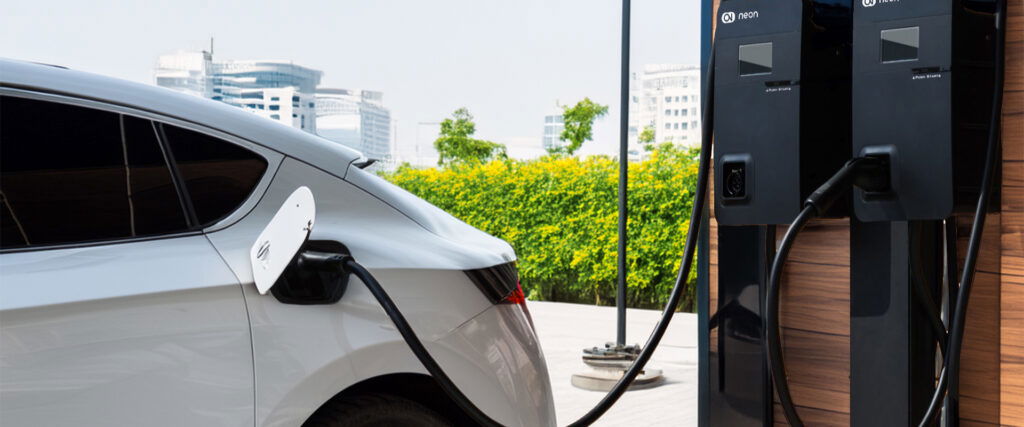
Smart chargers are designed to tackle the challenges above with robust software features that deliver operational intelligence and control. Neon’s suite of intelligent charging solutions empowers property managers and businesses to meet all their electric charging requirements efficiently.
- Dynamic Load Balancing. Smart chargers monitor energy usage in real time and distribute power based on demand and grid capacity. This allows businesses to avoid overloading circuits while maximizing charger availability.
- Remote Monitoring & Predictive Maintenance. Through continuous connectivity, smart chargers can alert operators to faults, temperature anomalies, or usage patterns that indicate wear or misuse. Maintenance teams can often resolve issues before they impact users.
- Customizable Access Control & Billing. With integrated authentication and billing systems, smart chargers support a range of business models—from free charging for employees to tiered pricing for different user groups.
- Cloud-Based Scalability. Smart charging platforms are built to scale. Adding new stations, managing multiple locations, or integrating with solar and storage systems is seamless with the right software ecosystem.
- Actionable Analytics. Smart chargers collect and analyze real-time data on usage, dwell time, energy costs, and emissions savings—allowing businesses to refine operations and demonstrate sustainability performance.
The Underestimated Value of Remote Support
One of the most overlooked but critically important advantages of smart charging systems is remote support. Many businesses assume physical maintenance is the primary way to resolve issues. In reality, the majority of charging problems ranging from software bugs and firmware mismatches to user errors and network glitches can be diagnosed and fixed remotely.
Benefits of remote support include:
- Rapid Response Times: Issues can be identified and addressed in minutes rather than days.
- Lower Maintenance Costs: Fewer site visits mean reduced labor and travel expenses.
- Higher Uptime: With constant monitoring and over-the-air updates, chargers spend more time online and available to users.
- Improved User Experience: Real-time resolution of issues translates to higher satisfaction and loyalty.
Conclusion: Investing in Smart Infrastructure
As commercial EV charging matures, businesses need solutions that are not only reliable but also intelligent and adaptive. Smart chargers backed by powerful software platforms and remote support capabilities offer the tools necessary to manage complexity, maximize ROI, and future-proof operations.
Choosing smart charging isn’t just a technology decision. It’s a commitment to operational excellence, customer satisfaction, and long-term growth in a fast-evolving transportation ecosystem.
For businesses ready to lead in the electrified future, smart chargers aren’t optional—they’re essential.
Reach out to our team now.